
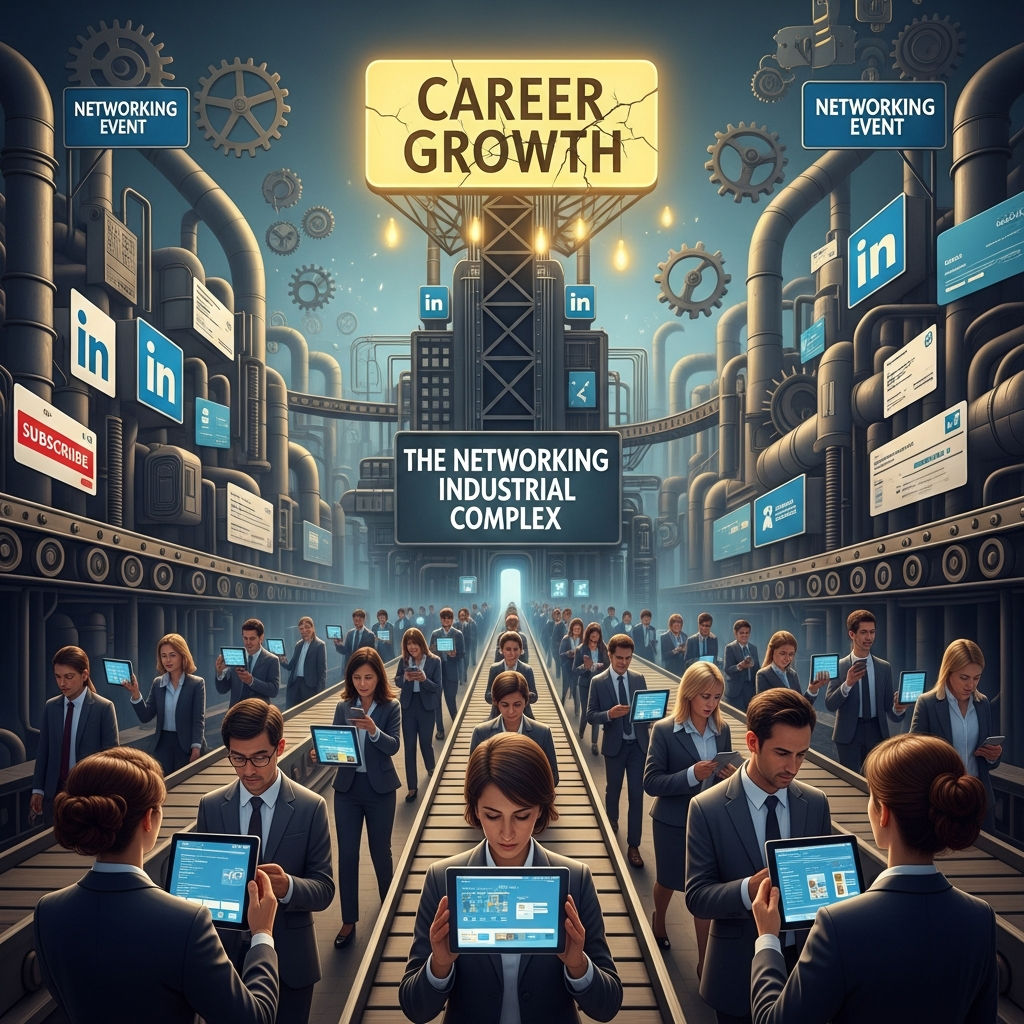
The Networking Industrial Complex Is Selling You a Lie About Career Growth
If you have spent more than five minutes on LinkedIn recently, you have likely seen the mantra: “Your network is your net worth.” It is the rallying cry of the modern professional world, pushed by career coaches, recruitment influencers, and Ivy League seminars. We are told that hard work is secondary, and that the “hidden job market” is a gated community where entry is only granted via a referral and a virtual coffee chat.
This ecosystem—what we can call the Networking Industrial Complex—has turned professional relationships into a transactional commodity. It promises that if you just send enough “cold reach-outs” and attend enough industry mixers, the doors to the C-suite will swing open. But for the vast majority of professionals, this is a lie. Not only is the “network-first” approach often ineffective, but it can actually actively stall your career growth by distracting you from the one thing that truly matters: your craft.
The Myth of the 80% Hidden Job Market
The cornerstone of the Networking Industrial Complex is a statistic often cited but rarely verified: that 80% of jobs are never posted online and are filled exclusively through networking. This figure is used to instill a sense of FOMO (Fear Of Missing Out) in job seekers, forcing them to spend hours “connecting” rather than applying or upskilling.
While internal referrals are certainly a valid recruitment channel, the “80% hidden market” narrative is largely a myth designed to sell networking courses and premium platform subscriptions. In reality, most high-growth companies—especially in tech and regulated industries—are legally or procedurally required to post roles publicly to ensure compliance and diversity. By focusing solely on the “hidden” market, you may be ignoring 90% of the visible, actionable opportunities that require actual merit to win.
The Danger of Transactional Relationships
The Networking Industrial Complex encourages a “quantity over quality” mindset. It rewards users for having 500+ connections, even if they wouldn’t recognize 450 of those people in a grocery store. This creates a culture of performative professionalism, where:
- People “reach out” with ulterior motives that are transparent and off-putting.
- Meaningful mentorship is replaced by “quick 15-minute chats” that provide no value to either party.
- LinkedIn feeds become echo chambers of toxic positivity and buzzword-heavy platitudes.
When networking becomes transactional, it loses its power. True career-altering opportunities come from deep, long-standing trust, not from a stranger you bothered during their lunch break because you liked their “thought leadership” post.
Why “Who You Know” is a Shortcut to Mediocrity
We have all heard the phrase, “It’s not what you know, it’s who you know.” While this contains a kernel of truth regarding access, it is a dangerous philosophy for long-term career sustainability. Relying solely on a network to bypass the rigors of competition leads to a phenomenon known as Network-Induced Mediocrity.
If you are hired primarily because of a connection, the expectations are often lower, or worse, skewed. Furthermore, if your “network” consists only of people like you, you are insulating yourself from the diverse perspectives and challenging environments that actually facilitate growth. The Networking Industrial Complex promotes a “clubby” atmosphere that discourages the radical skill acquisition required to stay relevant in an AI-driven economy.
The Meritocracy vs. The Network
While the “old boys’ club” still exists, the modern economy is increasingly rewarding proof of work. In fields like software engineering, data science, digital marketing, and creative design, a portfolio of successful projects outweighs a referral from a distant acquaintance. The Networking Industrial Complex wants you to believe you can talk your way into a role, but the market is increasingly demanding that you do your way into a role.
The Opportunity Cost of Constant Networking
Time is a zero-sum game. Every hour you spend at a forced “Happy Hour” or crafting the perfect cold message is an hour you are not spent mastering a new tool, leading a project, or deepening your expertise. This is the opportunity cost that career gurus never mention.
Consider the “High-Performer Trap”:
- The Networker: Spends 10 hours a week engaging on social media and attending webinars. Their visibility is high, but their output is average. When the industry shifts, they have “friends,” but no updated skills.
- The Builder: Spends those 10 hours mastering a new certification or building a side project. Their visibility is lower, but their value to the company is indispensable. When they do need to move, their “proof of work” makes them an easy hire.
The Networking Industrial Complex sells the easy path. Sending messages feels like work, but it doesn’t require the mental strain of Deep Work. It is a form of “productive procrastination.”
The Burnout of Performative Professionalism
There is a psychological toll to the “always-on” networking culture. Many professionals feel they can never truly disconnect because they must constantly curate their “personal brand.” This leads to a specific type of burnout where your professional identity is entirely tied to how others perceive you online, rather than your actual accomplishments.
This performative burden is exhausting. It forces introverts to act like extroverts and forces experts to act like influencers. When you stop “networking” and start “working,” the mental relief is often instantaneous. You regain the agency to let your results speak for themselves.
A Better Way: Selective, Strategic Alliances
Does this mean networking is useless? No. But it means the way it is being sold to you is wrong. Instead of following the Networking Industrial Complex’s playbook of mass-outreach and “personal branding,” consider a more organic, value-driven approach.
1. Focus on Proof of Work
Build things in public. Write articles that solve specific industry problems. Contribute to open-source projects. When you have a body of work, the network comes to you. You aren’t asking for a seat at the table; you are being invited because you have something to offer.
2. Cultivate “Weak Ties” Naturally
Sociology tells us that “weak ties” (acquaintances) are often more helpful for job hunts than close friends. However, these ties are best formed through shared activity, not cold outreach. Join a specialized niche community, a volunteer board, or a high-level masterclass. Relationships built through shared struggle or shared goals are infinitely stronger than those built via LinkedIn “Connect” buttons.
3. Depth Over Breadth
Instead of trying to meet 100 people, focus on five people you genuinely admire. Offer them value first. Help them with a project, share a relevant resource without being asked, or give them a genuine compliment on their work. A single advocate who knows your capabilities is worth more than a thousand “connections” who barely remember your name.
Conclusion: Escaping the Complex
The Networking Industrial Complex thrives on the insecurity of the modern worker. It sells the idea that you are always one connection away from your dream life, provided you stay active on their platforms and buy into their philosophies. But the secret to real career growth isn’t in your contact list—it’s in your capabilities.
Stop chasing influencers. Stop the “coffee chat” grind. Reclaim your time and reinvest it into becoming the best in your field. When you are undeniably good at what you do, the “hidden” job market finds a way to reveal itself to you. Career growth isn’t a social club; it’s a marathon of skill acquisition, and it’s time we started treating it that way.